
News
ChatGPT for digital forensic investigation: The good, the bad, and the unknown
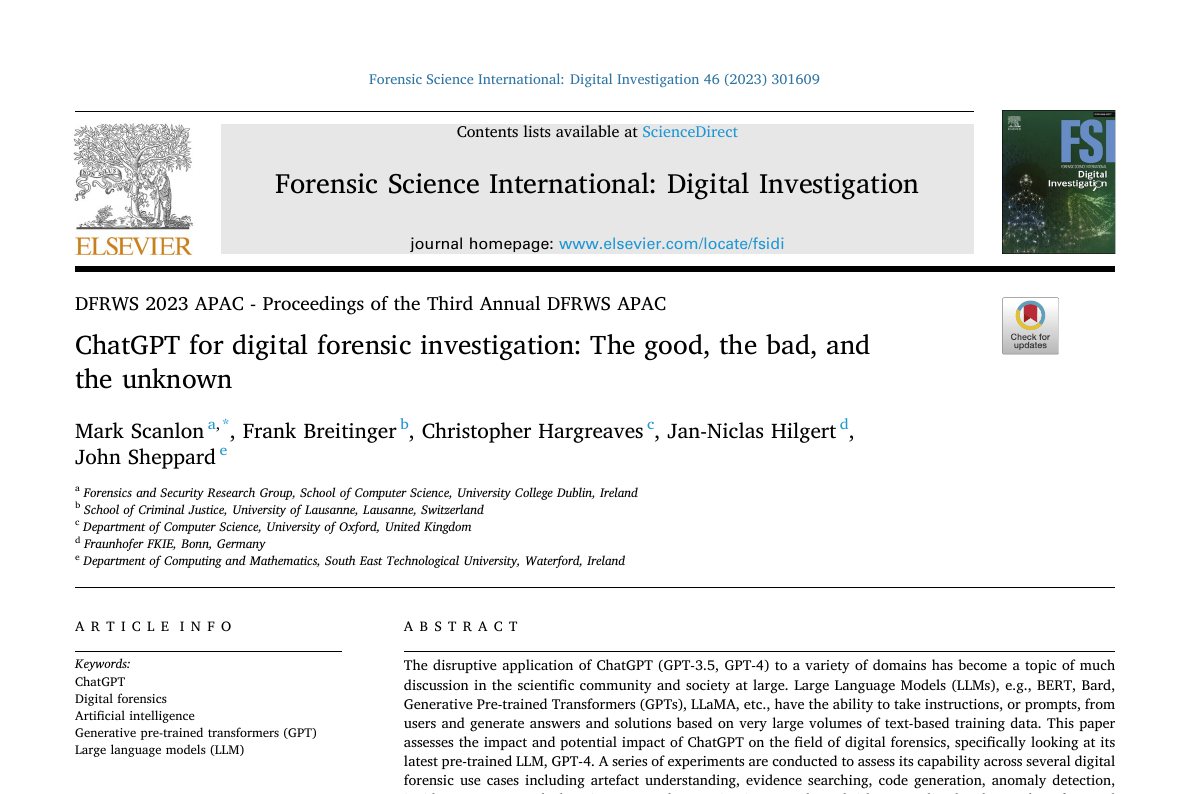
Congratulations to Mark Scanlon and co-authors Frank Breitinger, Christopher Hargreaves, Jan-Niclas Hilgert, and John Sheppard on the publication of ChatGPT for digital forensic investigation: The good, the bad, and the unknown in Forensic Science International: Digital Investigation.
Co-authors: Frank Breitinger, Christopher Hargreaves, Jan-Niclas Hilgert, and John Sheppard.
AI-generated summary of the contribution: This paper presents a comprehensive evaluation of the impact of ChatGPT on digital forensics, focusing on its latest pre-trained model, GPT-4. The study assesses ChatGPT’s capabilities in various digital forensic use cases, including artefact understanding, evidence searching, code generation, anomaly detection, incident response, and education. The authors conduct a series of experiments to evaluate ChatGPT’s strengths and risks in these areas, highlighting both the potential benefits and limitations of using ChatGPT in digital forensic investigations. The study concludes that while ChatGPT can be a useful supporting tool for knowledgeable users, it requires careful consideration of its strengths and weaknesses, particularly in terms of its potential for generating incorrect or misleading information. The paper also discusses the potential risks associated with using ChatGPT in digital forensic investigations, including the risk of relying on incorrect or incomplete information, and the need for investigators to critically evaluate the output of ChatGPT. The study provides a comprehensive overview of the current state of ChatGPT in digital forensics and highlights the need for further research in this area.